Anatomy of a Government Grant RFP: From the Grants.gov Notice to the Award
Sep 26, 2026
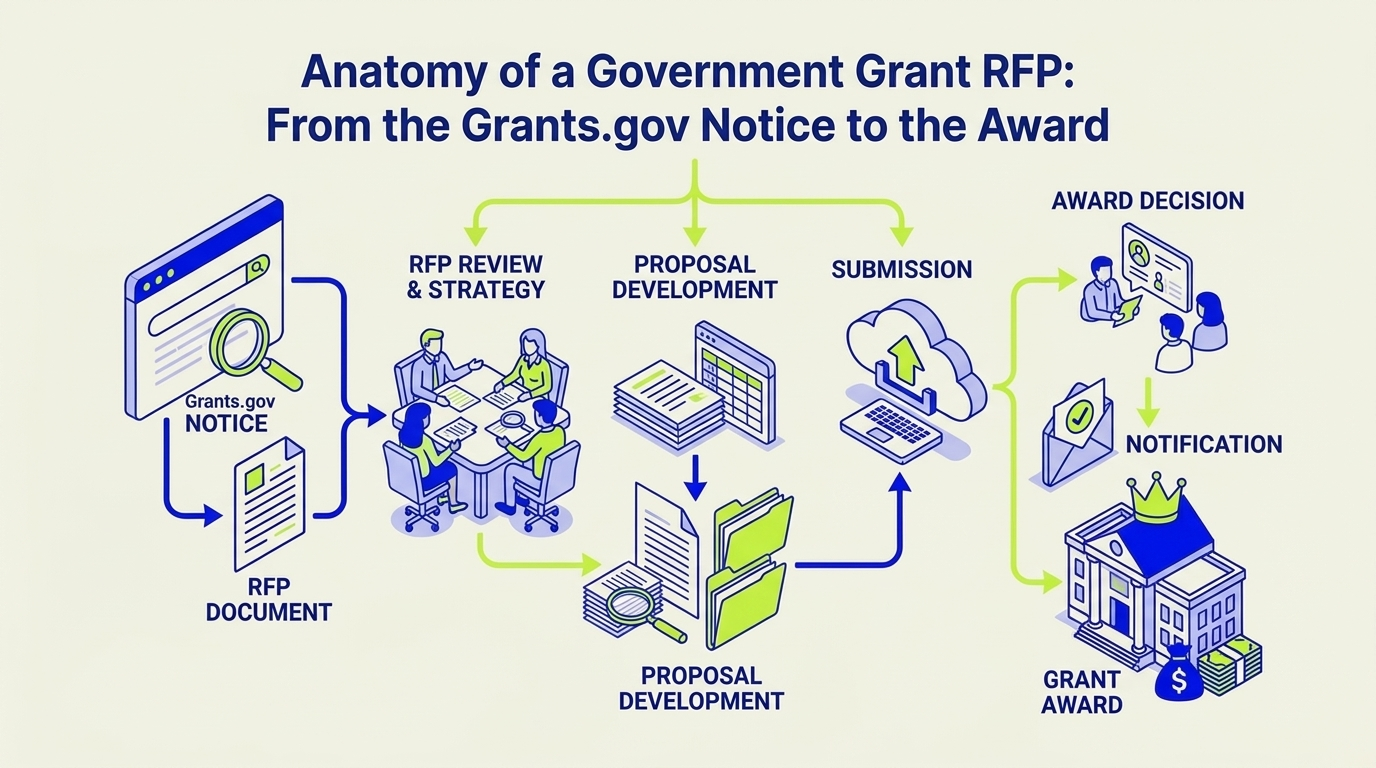
Most nonprofits lose federal grants before they write a single page. The loss happens at the go/no-go decision, in a missed amendment, or in a compliance matrix nobody built. The writing is rarely the first failure point. It is usually the third or fourth.
This post maps the full sequence, from the day a notice appears to the day the award is signed, and names where each step tends to go wrong.
First, know which door you are walking through
Federal opportunities post to two different systems, and they are not interchangeable.
SAM.gov posts contract opportunities: the government buying goods and services. Grants.gov posts financial assistance: grants and cooperative agreements from specific agencies, like the Department of Energy, the Department of Health and Human Services, and the Department of Justice, including its Office on Violence Against Women.
Both are RFPs, and both demand the same discipline. But the reviewers differ. Contracts are scored by procurement officials. Grants are scored by peer review panels, often outside experts reading your proposal cold, against review criteria the agency published in advance. If you are a nonprofit chasing grant funding, Grants.gov is your world, and the panel scoring model is what should shape everything you write.
Why federal grant RFPs are harder than they look
Three structural realities drive most of the complexity:
-
Peer review panels score what is on the page. Panelists cannot call you to ask what you meant. If a criterion is not answered in the narrative, it does not exist.
-
The review criteria are public and weighted. The notice tells you what each section is worth: need, project design, organizational capacity, budget. Funded applicants write to those weights. Unfunded applicants write what they wanted to say.
-
The timeline punishes late starts. A competitive federal grant application typically takes 4 to 8 weeks of focused work. Agencies allow 30 to 90 days between the synopsis and the deadline. The math does not work unless someone is watching the pipeline before the notice drops.
The process, step by step
| Step | What happens | Where it goes wrong |
|---|---|---|
| 1. Notice | The opportunity posts to Grants.gov from the funding agency (DOE, HHS, DOJ, OVW, and others). | Nobody in your organization sees it for two weeks. |
| 2. Go / no-go | An honest review against mission fit, eligibility, capacity, and track record. | A hopeful yes instead of an honest no, and 200 hours follow. |
| 3. Q&A window | Written questions to the program office and pre-application webinars. | Questions submitted late, or the webinar skipped. |
| 4. Compliance matrix | Every requirement from the notice mapped to the form, section, and person who covers it. | Skipped entirely; attachments assembled at the end. |
| 5. Drafting | Narrative, work plan, budget and justification, and letters of commitment written in parallel, against the published criteria. | Generic boilerplate where a scored answer was required. |
| 6. Red team review | Fresh eyes score the draft against the actual review criteria, before the deadline crunch. | Review by the writers themselves, which finds nothing. |
| 7. Submission | Upload through Grants.gov Workspace, which requires active SAM registration and a UEI. Validation errors block submission. | A lapsed SAM registration or a deadline-day upload. |
| 8. Evaluation | A peer review panel scores against the published criteria. Clarifications may follow. | Slow or thin answers to clarifications read as risk. |
| 9. Award | Notice of Award, or a declination with reviewer feedback you can request. | No postmortem, so the same mistakes repeat next cycle. |
The three failure points we see most
Starting at step 5. Organizations that find the notice with two weeks left start drafting immediately and never build the compliance matrix. Forms get missed, attachments get mismatched, and the proposal reads like a brochure.
Writing to your strengths, not the criteria. If project design is worth 40 points and your last proposal spent half its pages on organizational history, you wrote the wrong document. Mirror the criteria's weights in your page count.
Treating the budget as a last step. The budget and its justification carry real weight and must tell the same story as the narrative. A budget built in the final 48 hours, untested against the work plan, can sink a strong narrative.
What funded applicants do differently
They run steps 1 through 4 as an ongoing system, not a scramble. They track Grants.gov and agency forecast pages weekly. They keep a current library of reusable materials, so step 5 starts from 70 percent, not zero. And they treat every declination as data: reviewer feedback tells you where the criteria's real center of gravity is, and the next application gets sharper.
Are you considering pursuing government funding?
The applications that win tend to start months before the notice drops. Send us the opportunity, or even just the idea, and we will tell you within two business days whether it is worth pursuing, and what it would take to be competitive.