Build a Grants Calendar That Survives a Busy Month
Aug 19, 2026
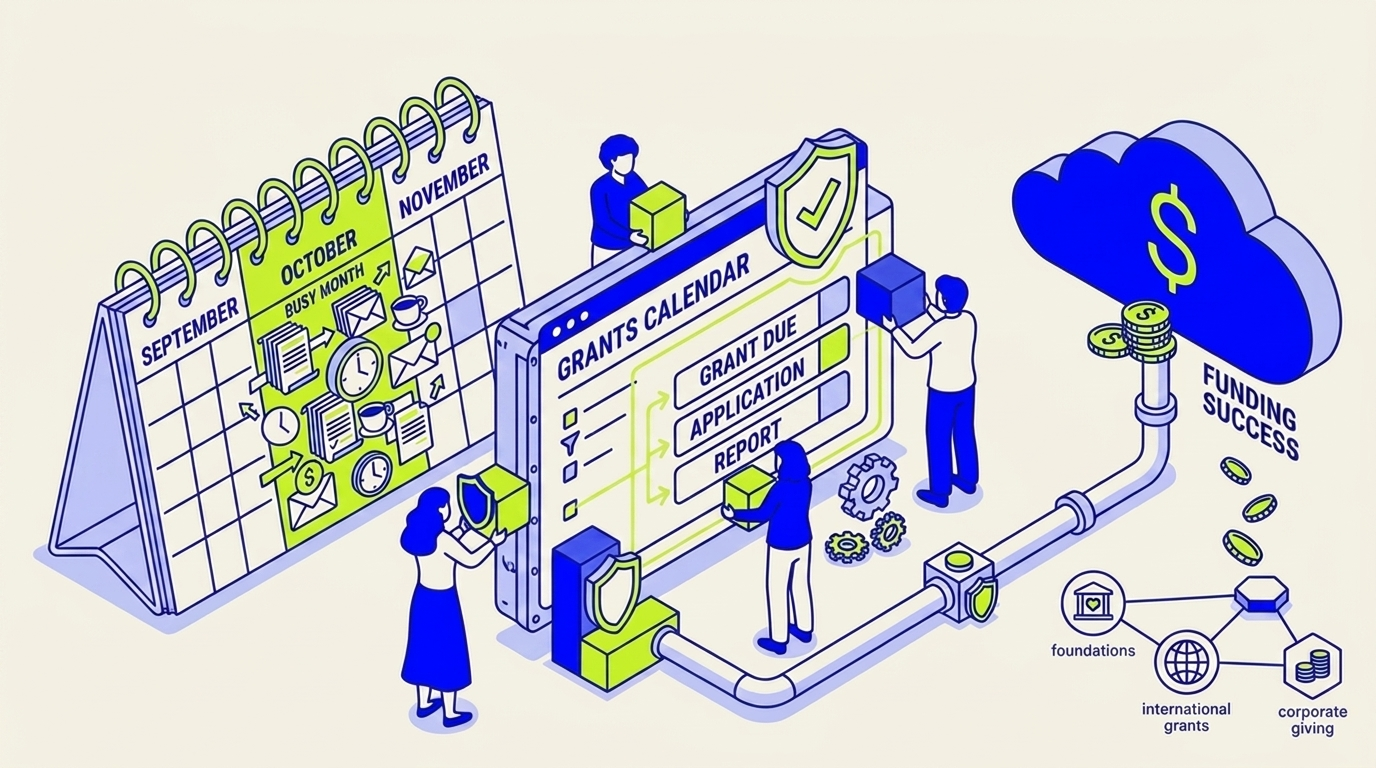
Every organization that does grant work eventually builds a calendar. Most of those calendars fail the same way. They work beautifully in January, when someone has just made them and everyone is paying attention, and they quietly stop reflecting reality by March, when a board report is due, two deadlines land in the same week, and the person who maintained the calendar is buried. By the time anyone looks at it again, it is wrong, and a wrong calendar is worse than no calendar, because people trust it right up until it fails them.
A grants calendar that survives is built differently from the start. It is designed around the weeks when nobody has time to maintain it, because those are the weeks it has to hold.
The problem is not the deadlines
Anyone can list deadlines. A calendar of due dates is easy to make and nearly useless, because the deadline is the last thing that matters, not the first. A proposal due March 1 is not a March 1 task. It is a February 1 first-draft task, a February 10 budget-approval task, a February 20 leadership-review task, and a February 27 final-assembly task, and if you only wrote down March 1, you learn about all of the earlier ones the week they are already overdue.
A calendar that survives works backward from each deadline and puts the real milestones on the actual weeks they belong to. It shows you that the third week of February is quietly brutal, three drafts and a budget all landing at once, long before that week arrives and there is nothing to be done about it. The value is not in recording deadlines. It is in seeing the pileups early enough to move something.
Build it around capacity, not opportunity
Most calendars are built as a list of everything the organization could apply for. That is the wrong foundation, because it treats the organization's time as unlimited, and it never is. A calendar built on opportunity always says yes to one more application, and the result is a team that applies to more and wins less, spread too thin across too many mediocre submissions.
A calendar built on capacity starts from a different question. How many strong proposals can this team actually produce in a quarter, at the quality that wins. That number is smaller than the number of opportunities, and it should be. Once you know it, the calendar stops being a wish list and becomes a set of decisions. These four, not those nine. This one moves to next cycle because it collides with the annual report. That one gets declined because it is a poor fit and the time is better spent elsewhere. The calendar becomes a tool for saying no on purpose, which is the only way a small team ever produces consistently good work.
Make the invisible work visible
The reason calendars drift is that most grant work is invisible until it is late. Reporting on grants you already won does not feel urgent until the report is due, so it never makes it onto the calendar, and then it collides with a proposal deadline and something gives. Renewals sneak up the same way. So does the slow work of building funder relationships, which has no deadline at all and therefore never gets scheduled, and therefore never happens.
A calendar that survives puts all of it on the same surface. New proposals, reports due, renewals coming, and the relationship work that has no hard date but matters more than any single application. When all of it is visible in one place, the collisions show up in advance, and the quiet work stops losing every fight against the loud work. A report due the same week as a proposal is a problem you can solve in advance and a crisis you cannot solve at all.
Assign it to a person, not a document
A calendar is not self-maintaining, and pretending it is guarantees it will rot. It needs one owner whose job is to keep it true, and that ownership has to be real, with time protected for it, not added to someone's plate as an afterthought they do when everything else is done. The maintenance is not much, perhaps an hour a week, but it has to actually happen, every week, including the weeks when there is no time, because those are exactly the weeks when the calendar is doing its most important work.
When the calendar has a real owner, it stays trusted. When it stays trusted, people plan around it, and the pileups get caught a month out instead of a week out. When no one owns it, it becomes a document everyone remembers making and no one believes, and the organization goes back to running on memory and adrenaline, which works until the month it does not.
Putting it together
A grants calendar is a small piece of infrastructure that quietly determines whether a team is in control of its year or reacting to it. Most organizations do not need a more complicated tool. They need a simpler system, built around their real capacity, owned by a real person, showing the pileups early enough to do something about them.
If your team is always one deadline behind and the calendar you have stopped being true a while ago, that is a fixable problem, and it is usually fixable in a single focused effort rather than a long one. If you want help building a grants calendar and pipeline your team can actually run, get in touch.