Grant Databases for Nonprofits: What's Free and What's Worth Paying For
Sep 16, 2026
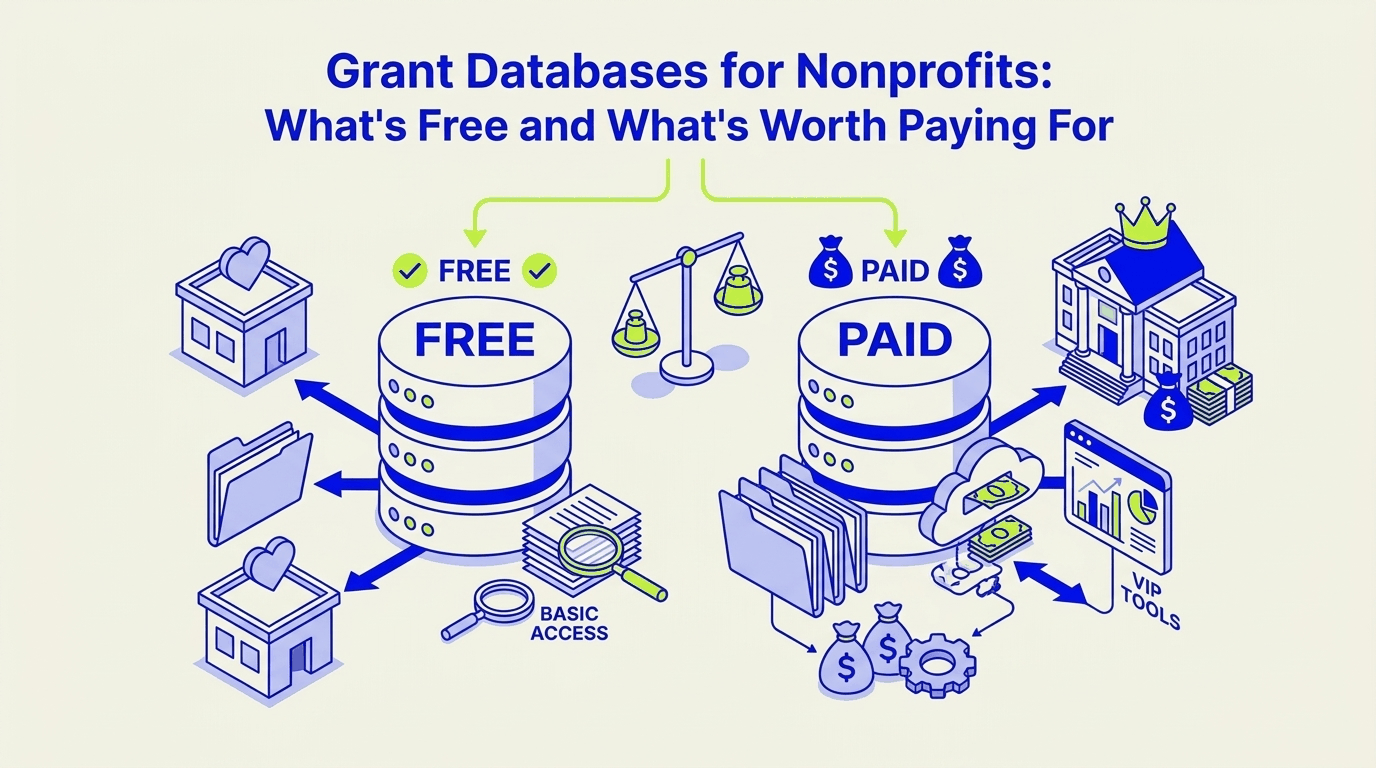
Every few weeks someone asks us which is the best grant database subscription to buy. Usually, the honest answer is "none yet." Most small nonprofits pay for a subscription before they've squeezed the free tools, and the free tools are better than their reputation.
What should you use before paying anything?
Grants.gov is the obvious starting point for federal funding, and its search is as clunky as everyone says. The trick is pairing it with USASpending.gov. Grants.gov tells you what's open. USASpending tells you who won last year, for how much, and how many awards the program actually made. Ten minutes on USASpending tells you whether a competition funds three organizations a year or three hundred, and that changes whether the application is worth your weekends.
For private foundations, the raw material is in the Form 990-PF, the annual return every private foundation files with the IRS. It lists every grant the foundation made, with recipient names and dollar amounts. Grantmakers.io and ProPublica's Nonprofit Explorer both make 990 data searchable for free. If a foundation says it funds "youth development" but its last three years of 990s are all universities and hospitals, you just saved yourself a proposal.
Two more free routes people skip: Your state may have a nonprofit association that maintains a funding calendar or a discounted database deal. And many public libraries carry Candid's Foundation Directory for cardholders, sometimes usable from home. In this case, a library card gets you into a database that costs at minimum $219 a month at list price. Ask at your local library's desk.
What do the paid databases cost in 2026?
Prices below are current as of September 2026. Vendors change tiers often enough that you should confirm on the checkout page before budgeting.
| Database | Price | What it is |
|---|---|---|
| GrantWatch | $249/year ($49/month) | Broad listings across foundation, corporate, state, and federal; about 11,700 verified opportunities |
| GrantStation | $199/year through the usual discount channels | 150,000+ funder profiles; strong on smaller foundations and civic clubs |
| Candid | $219/month or $1,199/year | The deepest foundation research tool: giving history, 990s, 300,000+ funder profiles |
| Instrumentl | From $299/month, billed annually | Discovery plus pipeline tracking, deadline alerts, and workflow tools |
Two pricing quirks worth knowing: GrantWatch's weekly plan ($22/week) looks harmless and annualizes to over $1,100 if you forget to cancel. And almost nobody should pay GrantStation's $699 list price; the same membership runs $199 through TechSoup and around $139 through many state associations.
Which one fits your organization?
If you apply to a handful of grants a year, GrantWatch or a discounted GrantStation is plenty. You're paying for the convenience of one search box instead of five websites, and at $200 a year that's a fair trade.
If foundation fundraising is a weekly activity, Candid earns its price. It's the tool you use to answer "has this funder ever supported an organization like ours, at our size, in our state" before you write a word.
Instrumentl makes sense at a different scale: ten or more active applications at once, deadlines slipping, more than one person touching the pipeline. At $3,588 a year it's a workflow purchase, not a research expense. Teams below that volume usually pay for features they never open.
What can't a database tell you?
Every one of these tools answers the same question: what exists. None of them answer the question that decides outcomes, which is whether your organization is a credible applicant for this specific award. That judgment comes from reading a funder's actual giving history, checking eligibility fine print, and being honest about your own capacity. We covered the search side of that in our earlier post on where to look for grants.
The other thing no database fixes is timing. Most opportunities that matter to you will have been findable for free weeks before a subscription surfaces them. A database buys you hours, not access. If you're staring at a list of fifty "matches" and can't tell which three are worth it, that's a normal place to be, and it's fixable in a working session or two.
A database can't provide a meaningful relationship. Impactful, lasting funding sources don't come from last-minute, blind submissions. If you're looking for sustainable revenue generation, you need strategy and meaningful funder relationships. Let's talk; AGM Impact can help you start building funding resiliency.